One of the most common conversations I have with women at my Southampton, PA office starts with a similar question: “I’m unhappy with my breasts, but I’m not sure what I actually need.” They know something isn’t right. Maybe their breasts have lost their youthful shape after pregnancy and breastfeeding. Maybe they’ve always wished for more fullness. Or maybe they’ve noticed changes after weight loss that left their breasts looking deflated and lower on their chest than they used to be.
The confusion between breast lift and breast augmentation is completely understandable. Both procedures improve the appearance of the breasts, and from the outside, it can seem like they do similar things. But they actually address two very different problems, and understanding that distinction is the key to getting results you’ll love.
Let me walk you through exactly how each procedure works, what problems each one solves, and how to determine which approach — or combination of approaches — is right for your body and your goals.
What You’ll Learn
- Two Different Problems, Two Different Solutions
- When a Breast Lift Is the Right Choice
- When Breast Augmentation Makes Sense
- When You Need Both: The Breast Lift with Implants
- The Simple Self-Assessment
- What to Expect During Your Consultation
- Frequently Asked Questions
- Schedule Your Free Consultation
Two Different Problems, Two Different Solutions
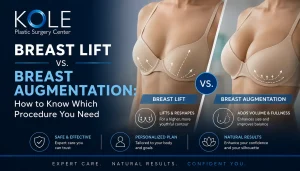
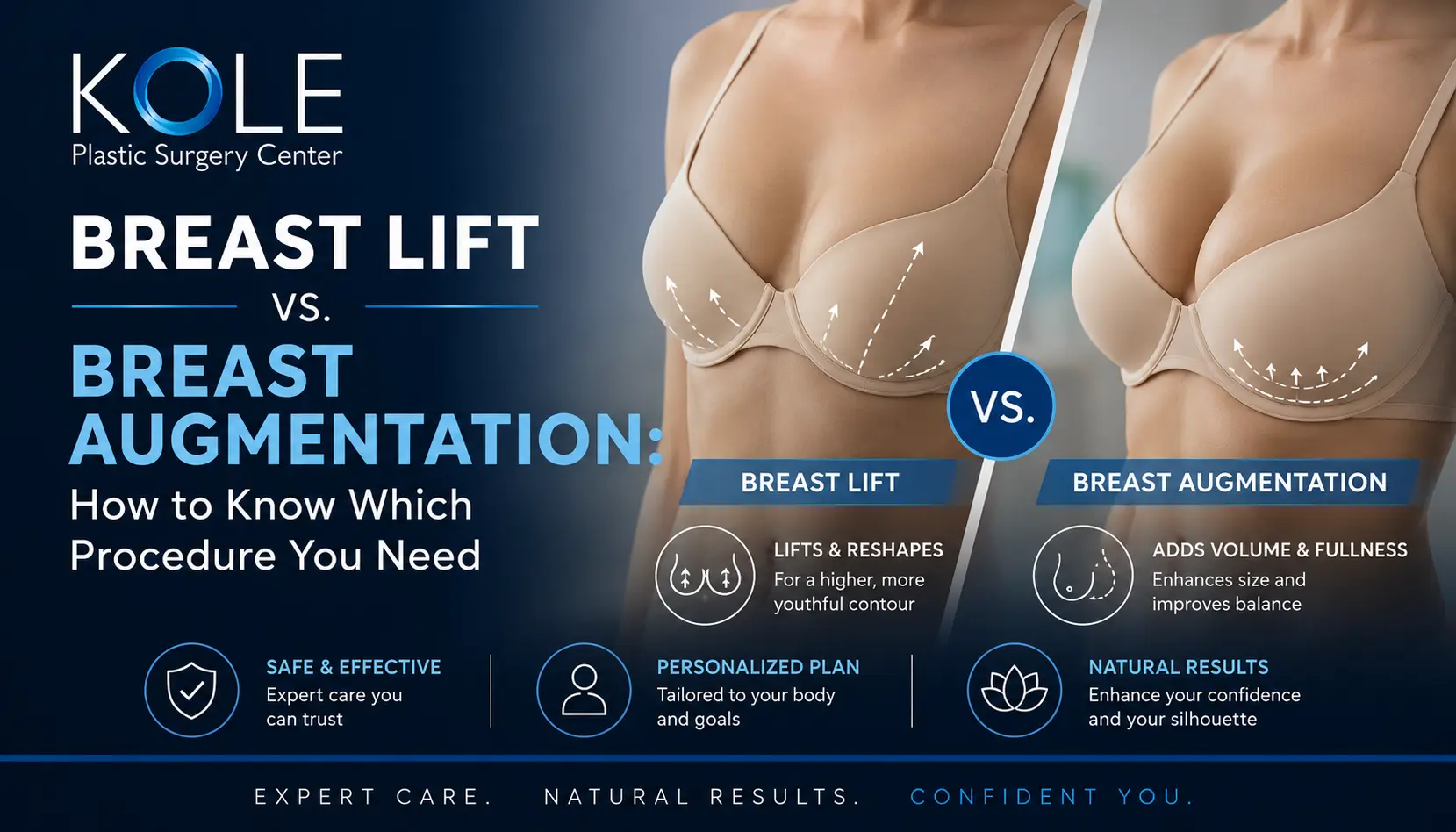
The simplest way to understand the difference between these procedures is this: a breast lift addresses position, while breast augmentation addresses size.
A breast lift, which surgeons call mastopexy, corrects sagging. Over time, factors like pregnancy, breastfeeding, weight fluctuations, gravity, and the natural aging process cause breast tissue to descend on the chest wall. The nipple drops to a lower position, sometimes pointing downward. The upper portion of the breast loses its fullness, and the overall shape becomes elongated or deflated. A breast lift removes excess skin, reshapes the breast tissue, and repositions the nipple-areola complex higher on the breast mound. The result is a firmer, more youthful contour.
Breast augmentation, on the other hand, increases volume. Using implants — either saline or silicone — the procedure enhances breast size and creates fuller, rounder contours. Augmentation is ideal for women who feel their breasts are too small for their frame, who want more upper pole fullness, or who have naturally asymmetric breasts they’d like to balance.
Here’s what’s critical to understand: a breast lift will not make your breasts larger, and breast augmentation alone will not fix significant sagging. They solve different problems. Choosing the wrong procedure leads to disappointment, which is why getting an accurate assessment during your consultation is so important.
When a Breast Lift Is the Right Choice
A breast lift is typically the right procedure when sagging — what we call ptosis — is your primary concern and you’re satisfied with your breast size. You may be a good candidate for a breast lift if your nipples point downward or fall below the crease under your breast, if your breasts have lost their shape and look flat or elongated, if you have significant asymmetry in how your breasts sit on your chest, or if stretched skin makes your breasts appear deflated.
The causes of breast ptosis are varied. Pregnancy and breastfeeding are among the most common. The breast tissue expands during pregnancy and lactation, and when milk production ends, the glandular tissue shrinks but the skin that stretched to accommodate it doesn’t always bounce back. Weight loss has a similar effect — particularly the rapid weight loss many patients experience with GLP-1 medications or bariatric surgery. Genetics play a role too. Some women simply have less elastic skin or breast tissue that’s more prone to sagging over time.
According to the American Society of Plastic Surgeons, breast lifts have seen a dramatic increase in popularity in recent years — rising 30% between 2019 and 2022. In 2024, ASPS member surgeons performed over 153,000 breast lift procedures, making it one of the top five most common cosmetic surgeries in the country. This growth reflects an important shift in how women are thinking about breast enhancement: many are prioritizing shape and position over size, wanting to look naturally youthful rather than dramatically different.
One approach I use frequently is called auto-augmentation, where I reshape and reposition the patient’s own breast tissue during the lift to create upper pole fullness without implants. This technique can give the appearance of a modest size increase while still feeling completely natural, because you’re working with your own tissue rather than adding a foreign device.
When Breast Augmentation Makes Sense
Breast augmentation is the right choice when volume is your primary concern and your breasts sit in a good position on your chest with minimal sagging. You may be a candidate for augmentation if you feel your breasts are too small for your body proportions, if you want more fullness in the upper portion of your breasts, if you have naturally asymmetric breasts you’d like to make more even, or if you lost breast volume after pregnancy or weight loss but don’t have significant sagging.
Breast augmentation remains one of the most popular cosmetic procedures in the United States, with over 306,000 performed by ASPS member surgeons in 2024. What’s changed significantly in recent years is the type of result patients are requesting. The trend has shifted decisively toward smaller, more proportionate implants that complement a woman’s frame rather than dramatically alter it. Patients throughout Bucks County and the Greater Philadelphia area consistently tell me they want breasts that look natural — enhanced, but not obviously augmented.
During a consultation, I spend considerable time discussing implant options. Factors like implant type (silicone vs. saline), shape (round vs. anatomical), profile (how much the implant projects from the chest), and size all influence the final result. I use Crisalix 3D imaging technology to show patients exactly what different implant options would look like on their specific body. This takes the guesswork out of the decision and helps ensure you end up with the result you actually want.
It’s worth noting that breast augmentation alone will not correct sagging. If you have even moderate ptosis and receive only implants, you may end up with breasts that are larger but still droop. The implant adds weight, which can actually make sagging more pronounced over time. This is exactly why an accurate assessment during consultation is so important — recommending the wrong procedure does patients a disservice.
When You Need Both: The Breast Lift with Implants
Many women present with both concerns: their breasts have lost volume and they sag. In these cases, the best result comes from combining a breast lift with augmentation in a single procedure, which we call augmentation mastopexy.
This combined approach addresses both problems simultaneously. The lift component removes excess skin, reshapes the tissue, and repositions the nipple to a more youthful location. The augmentation component adds volume and fullness, particularly in the upper portion of the breast. The result is breasts that are both lifted and fuller — perky and proportionate.
Combining procedures has practical advantages too. You undergo anesthesia once, recover once, and achieve your final result in a single surgical journey rather than spacing procedures months apart. For many patients, this efficiency is a significant benefit.
That said, combination surgery is more complex than either procedure alone. It requires a surgeon with significant experience in both breast lifting and augmentation techniques, as well as the judgment to balance the two goals appropriately. The breast tissue is being lifted and tightened at the same time an implant is being placed, which requires careful surgical planning to ensure optimal healing and a beautiful result.
At Kole Plastic Surgery Center, I evaluate each patient individually to determine whether a combined approach is appropriate or whether staging the procedures — performing the lift first and adding implants later — would produce a better outcome. This decision depends on factors like the degree of ptosis, the desired implant size, and the quality of the breast tissue and skin.
The Simple Self-Assessment
While nothing replaces an in-person consultation with a board-certified plastic surgeon, there’s a simple test you can do at home to get an initial sense of what you might need.
Stand in front of a mirror without a bra. Look at where your nipple sits in relation to the crease underneath your breast (the inframammary fold). If your nipple is above the fold and pointing forward, you likely have minimal sagging. If your nipple is at the level of the fold, you have mild ptosis. If your nipple falls below the fold or points downward, you have moderate to severe ptosis that would benefit from a lift.
Next, consider your volume. Cup your breasts with your hands and lift them to approximately where you’d like them to sit. If you’re happy with the size but just wish they were higher and firmer, a lift alone may be sufficient. If you find yourself wishing there was more to lift — more fullness, more projection — you’re likely a candidate for augmentation or a combination procedure.
This self-assessment gives you a starting point, but the nuances matter enormously. Factors like skin elasticity, breast tissue quality, chest wall shape, and your aesthetic goals all influence the recommendation. This is why I conduct every consultation personally and take as much time as needed to evaluate your anatomy and understand what you’re hoping to achieve.
What to Expect During Your Consultation
When you come to Kole Plastic Surgery Center for a breast consultation, I examine your breasts carefully, take measurements, and discuss your goals in detail. I explain exactly what I see and what procedures would address your specific concerns. I use drawings and Crisalix 3D imaging so you can visualize what different approaches would look like on your body.
I also believe in being direct. If you come in thinking you need one procedure but my examination suggests another would serve you better, I tell you. My job is to help you make an informed decision, not to sell you on a particular surgery. With over 25 years of experience as a double board-certified plastic surgeon, I’ve seen what works and what doesn’t, and I share that knowledge openly.
All breast procedures at Kole Plastic Surgery Center are performed in our private, PA Department of Health licensed ambulatory surgical center — the only facility of its kind in Bucks County. Operating since 2005, our center provides a calm, private environment with one-on-one nursing care and board-certified anesthesiologists. Patients consistently tell us the experience feels less stressful and more personal than a hospital setting.
Frequently Asked Questions
What is the difference between a breast lift and breast augmentation? A breast lift (mastopexy) corrects sagging by removing excess skin and repositioning the nipple higher on the breast. It improves shape and position without changing size. Breast augmentation uses implants to increase volume and fullness. The procedures address different concerns — position vs. size — and many women benefit from combining both.
How do I know if I need a breast lift or implants? If your primary concern is sagging — nipples that point downward or fall below the breast crease — you likely need a lift. If you’re happy with your breast position but want more volume, augmentation may be right. If you have both sagging and volume loss, a combined procedure addresses both. Dr. Kole evaluates your specific anatomy during a free consultation to make personalized recommendations.
Can a breast lift and augmentation be done at the same time? Yes. This combined procedure, called augmentation mastopexy, addresses both sagging and volume loss in a single surgery. It requires a surgeon experienced in both techniques. Dr. Kole evaluates each patient individually to determine whether combining procedures or staging them separately would produce the best result.
How much does breast surgery cost in Bucks County? Costs vary depending on the procedure — lift alone, augmentation alone, or combined — as well as the type of implants used and the complexity of your case. During your free consultation at Kole Plastic Surgery Center, all costs are discussed transparently. Financing through CareCredit, United Medical Credit, and Advanced Care is available.
Will my breast lift results look natural? Yes. Modern breast lift techniques focus on creating natural-looking results. Dr. Kole uses techniques like auto-augmentation, which reshapes your own breast tissue to create upper pole fullness without implants. The goal is a youthful, proportionate appearance that looks like you — just refreshed.
What is recovery like after breast lift or augmentation? Most patients return to light activities within one to two weeks and can resume normal exercise at around six weeks. You’ll wear a supportive surgical bra during initial healing. Dr. Kole provides detailed recovery instructions and personally follows up with every patient after surgery to monitor progress.
Will I have scars after a breast lift? Yes, breast lift surgery involves incisions that result in scars. The pattern depends on the degree of lift needed — ranging from scars around the areola only to additional vertical and horizontal incisions. Dr. Kole places incisions to minimize visibility, and scars fade significantly over time. Most patients feel the improved shape far outweighs the presence of scars.
How long do breast augmentation results last? Breast implants are not lifetime devices, though many last 10-20 years or longer. You may eventually need replacement due to natural aging, implant wear, or changes in your preferences. Breast lift results are long-lasting but your breasts will continue to age naturally. Maintaining a stable weight helps preserve results from either procedure.
Am I a good candidate for breast surgery? Good candidates are in overall good health, at a stable weight, non-smokers (or willing to quit), and have realistic expectations. Women who are pregnant, breastfeeding, or planning pregnancy soon should typically wait. Dr. Kole evaluates candidacy during your consultation and discusses any factors that might affect your results.
Does Dr. Kole offer free consultations for breast procedures? Yes. Dr. Kole offers complimentary, no-obligation consultations for all breast procedures. He personally meets with every patient to examine their anatomy, discuss goals, explain options, and use 3D imaging to help visualize potential results. Call (215) 315-7655 to schedule your consultation at our Southampton, PA office.
Summary
Choosing between a breast lift and breast augmentation — or determining whether you need both — comes down to understanding what’s actually causing your dissatisfaction. Here’s what to remember:
- A breast lift corrects sagging and repositions the nipple without changing breast size
- Breast augmentation increases volume but does not fix significant sagging
- Many women benefit from combining both procedures for lifted, fuller results
- ASPS reports over 306,000 augmentations and 153,000 lifts performed in 2024, with growing demand for natural-looking outcomes
- An accurate assessment from a board-certified plastic surgeon is essential for choosing the right procedure
If you’ve been wondering which breast procedure is right for you, the answer becomes clear once a qualified surgeon evaluates your anatomy and listens to your goals. I’d welcome the opportunity to meet with you, examine your concerns, and explain exactly what I recommend and why.
Contact Kole Plastic Surgery Center today to schedule your free, no-obligation consultation. Call (215) 315-7655 or visit us at 1122 Street Road, Suite 100, Southampton, PA 18966. We serve patients throughout Bucks County, Montgomery County, Philadelphia, Newtown, Langhorne, Doylestown, and the surrounding communities.
About the Author
Dr. Edward S. Kole, DO is a double board-certified plastic surgeon specializing in cosmetic and reconstructive surgery at Kole Plastic Surgery Center in Southampton, PA. After graduating with honors from the New York College of Osteopathic Medicine, Dr. Kole completed five years of General Surgery training followed by a second residency in Plastic and Reconstructive Surgery. He is board-certified in both General Surgery and Plastic & Reconstructive Surgery by the American Osteopathic Board of Surgery. Dr. Kole has been in private practice since 1998 and operates the area’s only private PA Department of Health licensed ambulatory surgical center. Named Bucks County’s Best 2025 and featured in Marie Claire Magazine, Dr. Kole believes that informed patients make the best decisions.